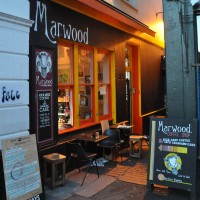
The Marwood

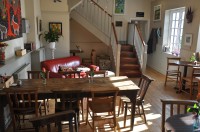
The Marwood, tucked away in an alley of Ship Street, BrightonRight in the heart of Brighton’s Lanes, tucked away in a corner next to Café Coho, is The Marwood. It is perhaps the most Brighton-like of all Brighton’s many and varied coffee shops. To call it quirky would be an understatement: The Marwood is quite possibly the most eclectic place I have visited since I started the Coffee Spot.

I first ran across it as a showcase for Google Maps new “walk-through” feature. As soon as I saw it, I knew I had to go there! Of course, quirky can be a double-edged sword: if quirky is used as a gimmick, then it rapidly gets stale. Similarly, quirky without good coffee wouldn’t amount to much either.

Fortunately, The Marwood puts its money where its mouth is, with a classic espresso from Southampton roasters, Mozzo. There’s no third-wave experimentation here, no pour-overs or fancy preparation methods. In fact, the coffee is probably the most straightforward aspect of the whole place. Although it describes itself as a coffee house, The Marwood also does food and serves wine, spirits and bottled beer, as well as offering a variety of different spaces in which to hang out.
Continue reading

Angelina, rue de Rivoli

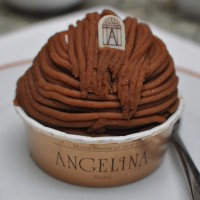
The Mont Blanc from AngelinaAngelina is something of a Paris institution, a grand Salon du Thé which exudes class, even more so than the venerable Café de Flore. From its shop on the rue de Rivoli, on the north edge of the Tuileries Gardens, it’s been serving the folk of Paris (and its fair share of visitors too: judging by the accents, faces and amount of English being spoken, Angelina is a major tourist draw) with exquisite cakes, artery-clogging hot chocolate and fine coffee since 1903.

While you might go to Café de Flore or its neighbour, Les Deux Magots, for the coffee, the people watching or the general ambience, with Angelina, you are definitely paying for the elegant surroundings and the (quite possibly literally) to-die-for patisserie such as the legendary Mont Blanc or the signature hot chocolate, l’Africain.

If you can’t get to the rue de Rivoli (or can’t get in!) there are other branches around Paris (plus one in Lyon and nine in Japan!). Alternatively, rue de Rivoli has a takeaway counter (useful for the budget-conscious). I’ve only tried the branch in the Louvre, which, while serving the same excellent fare, doesn’t quite have the same class as the rue de Rivoli original.

Continue reading

Café Mila

The downstairs at Cafe Mila, bathed in sunlight.Café Mila, just off Godalming’s historic High Street, is a wonderful spot. I’m embarrassed to confess that it’s taken me so long to discover it: after all, from my house it’s only a couple of hours’ stroll away across the Surrey hills, then down along the River Wey (or 10 minutes by train if you’re in a hurry). Nor can I plead ignorance; my friends in the area have been telling me to go there for a while now.

Café Mila will be celebrating its second birthday in October. Set up by South-African Steve and his wife Jane, what makes it so special is the combination of its setting (a courtyard just off the High Street) and the warm, welcoming atmosphere created by Steve and his cheerful staff. You can usually find Steve on the premises and I was also fortunate enough to meet Jane.

It helps that the coffee is good, while the cakes and food, all baked/made on the premises, are excellent. I liked it so much that I visited twice, once with a friend for Sunday brunch (which was excellent) and then again one afternoon the following week for a more extended visit.

Continue reading

Coutume

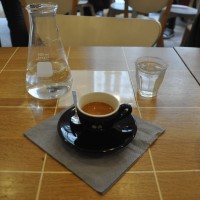
A very fine espresso in a hard to photograph black cup from Coutume, complete with carafe of water.Coutume is something of an old hand in the (relatively new) Parisian third-wave coffee scene. On the left bank, on the relatively untrodden (by tourists, at least) rue de Babylone, it is both a roaster (which supplies the likes of Black Market) and a café in its own right. Of the three third-wave cafés I visited on my trip to Paris in May, character-wise it sits between Ten Belles, which felt as if it had been lifted straight out of Soho, and Black Market, which felt like a little French café/bar.

On the one hand, Coutume felt undeniably French, particular since it was the only one of the three to offer table service. It also seemed to have the most local custom. On the other hand, if I closed my ears and took down the menus, it too could have been lifted straight out of Soho, with its tiled counters and bare, undecorated walls.

Not that this is any criticism; of the three, I preferred the coffee at Coutume, although it was a close-run thing with Black Market. I also loved the atmosphere, it being a great place to drink great coffee.

August 2014: you can see what I made of Coutume on my return visit in 2014.

Continue reading

Bean About Town, Kentish Town

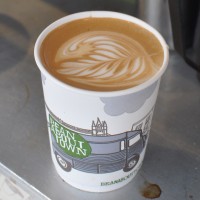
A latte, complete with latte art by Rory, in a Bean About Town takeaway cup from the Kentish Town cart.For a while now, I’ve been describing Bean About Town’s Coffee Van at the Real Food Market at London’s South Bank Centre as my favourite coffee cart/van/barrow/stall. While the coffee is excellent and I like Bean About Town in general, an awful lot of this has to do with Claire, the French barista who runs the South Bank van on Fridays and at the weekend. For the rest of the week, Claire can be found at Bean About Town’s coffee barrow at Kentish Town. Or so I was told.

This is the story of how I made the long, long journey to Kentish town (four stops on the Northern Line, Charing Cross Branch, heading north from Euston) only to find that Claire had grown a beard and changed her name to Rory… Either that or I’d missed her shift by a couple of hours… I’ll let you decide…

Continue reading

Workhouse Coffee, King Street

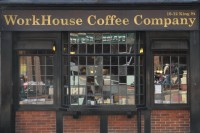
Workhouse Coffee Company on the ground floor of the George Hotel in ReadingYou know how it goes. You go to a coffee shop, you love it; you go to another branch, you don’t like it. It’s always a danger and so it was with the King Street branch of Workhouse Coffee. I think I’d been subconsciously avoiding it, having visited the original Workhouse Coffee on Oxford Road in West Reading at the start of the year. That was a small, intimate and lovely place to drink coffee and I worried that the much bigger King Street, in the centre of Reading, wouldn’t live up to my high expectations.

My fears were, of course, groundless: if anything, King Street is even better. From the moment I stepped inside, I loved the place. Very different from Oxford Road, it’s still small enough to be intimate, while its bustle adds a whole new dimension. How I longed for a place like this when I was a regular visitor to Reading 10 years ago!

As well as running the two coffee shops, Workhouse roasts its own beans, offering (while I was there) a single origin, two blends and a decaf as espresso and all its beans as pour-over fitler or for sale (beans or ground).

Continue reading

The Fields Beneath

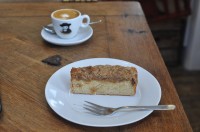
A very small coffee (recommended by Jess) and a slice of Apricot crumble (recommended by Vanessa) at The Fields BeneathIt’s almost impossible not to like The Fields Beneath, located underneath North London’s Kentish Town West train station. From the moment I saw it, I was sold, but if I’d been in any doubt, the warm and friendly greeting I got from baristas Jess and her colleague Vanessa would have won me over. Although they “only” work there, their affection for and dedication to The Fields Beneath puts some owners I know to shame.

It helps that The Fields Beneath serves excellent coffee from regularly rotating roasters, which means you’ll always be in for a surprise! However, it’s served without a hint of pretension and none of the snobbery that sometimes plagues such places. Jess was equally happy discussing the finer points of roasting with me and serving a “black coffee” to the next customer who came in.

It also helps that the cakes, pastries and bread (I tried the lot) are divine and that The Fields Beneath is a lovely place in which to eat them/drink the coffee. The only downside I can see is that the line serving the station, part of the London Overground network, doesn’t actually connect to any of the stations that I regularly use!

Continue reading

Doctor Espresso Caffetteria

A lovely double-espresso from Dr Espresso's 1956 Gaggia lever machine served in a very musical cupI first met Russell, or Doctor Espresso, as he is better known, at the Caffe Culture Show, where he threatened to come to see me on Christmas Day with a baseball bat (presumably as a present) if I didn’t visit his newly-opened café in Putney. So, one sticky summer’s evening in August, I fulfilled my promise, doing myself out of a Christmas present in the process…

Putney is rapidly becoming a speciality coffee hub for southwest London, with Doctor Espresso starting his own outpost just over the river, on the north bank of the Thames. However, third -wave coffee aficionados need not apply: Doctor Espresso Caffetteria is a lovely Italian-style café/espresso bar, distinctly old-school in outlook. It has London’s oldest working espresso machine, a classic Gaggia Tipo America, which is a joy to behold.

Of course, a venerable machine is of no use at all if the coffee coming out of it isn’t up to scratch, but fortunately Doctor Espresso’s Gaggia delivers a classic Italian espresso, using beans roasted in Italy: a fitting tribute to the great machine. This is backed up by some lovely Italian food: panini, calzone, pizza, pasta & salad, along with some delicious cakes and pastries.

Continue reading

Notes, Trafalgar Square

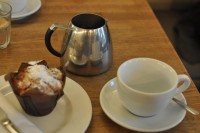
Filter Coffee from Notes, served in a silver coffee pot, plus a muffin.Notes is one of those places that I have a love-hate relationship with. In theory, I really ought to love Notes. Unlike many modern coffee shops, Notes is decidedly upmarket. As much wine bar as café, with food to boot, the Trafalgar Square branch (although these comments applied equally to the nearby Covent Garden Notes, which is now closed) exudes quality. It has the setting and a certain elegance that would normally have me gushing with praise.

So, why do I sometimes find myself fidgety and ill-at-ease when I’m in Notes? Well, it’s not the coffee, which is excellent, nor is it the decor, which is wonderful. It is, in fact, the noise. Notes can be downright loud at times and sometimes, for me, loud is fine. And sometimes it’s not. I’m very binary like that, and when something crosses that line, it’s time to leave.

Which is a shame, since if I pick my moments, I find that I really like Notes. I like the coffee, there’s food all through the day, it’s open late into the evenings, the list goes on. The only thing that’s missing is Wifi (long since rectified, by the way).

So, if you can stand the (sometimes) noisy surroundings, I present Notes, Trafalgar Square.

July 2020: Notes has reopened, offering sit-in and takeaway services. You can see what I made of it when I visited.

Continue reading

Caffeine Magazine

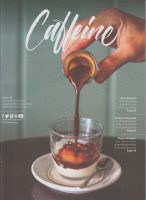
The cover of Issue 34 of Caffeine Magazine, an espresso being poured over ice cream to make an affogato.Issue 34 of Caffeine Magazine, came out a couple of weeks ago. If you’re new to the Coffee Spot or you haven’t heard of Caffeine Magazine, then you’re missing out, since it’s long been one of the UK’s foremost coffee publications.

As regular readers will know, I used to be Caffeine Magazine’s UK café correspondent. I made my debut in Issue 4, writing the Neighbourhood Watch feature, in which I explored the coffee scene in towns & cities around the UK, with my articles graced and enhanced by the wonderful photography of Amelia Hallsworth. In all, I wrote 26 Neighbourhood Watch features, with the last one appearing in Issue 31 (I got Issue 21 and Issue 28 off for good behaviour!). There’s more about Neighbourhood Watch and why we decided to bring it to an end here.

Caffeine publishes bi-monthly and is available for free in many good independent, speciality coffee shops around the country, with a particular emphasis on London. However, if you’re struggling to find a copy, it’s also available on-line for both Apple and other platforms (including Apple, Android, Kindle and Windows 8). Even better, there’s a postal subscription available; a year’s worth of Caffeine Magazine for just £23 (postage included, UK only; higher prices for Europe and worldwide). You can also order back issues, although many of the early ones have sold out.

Continue reading