
Meet the Roaster: Neighbourhood Coffee

Detail from the label to Neighbourhood Coffee's Brazil Sitio Jacutinga: "(You Gotta) Fight For Your Right (To Latte)", witth tasting notes of black cherry, milk chocolate and praline. The coffee is naturally-processed (patio-dried) and consists of red and yellow catuai varietals grown at 1,200m altitude.Liverpool’s Neighbourhood Coffee has come a long way since I first met the founders, Ed and Chris, at Cup North in 2015, the year Neighbourhood was founded. Although the company was new, Ed and Chris were old hands in the coffee business, having previously worked for green-bean importers and African coffee specialists, Schluter (now part of Olam). Back then, Neighbourhood was Liverpool’s first speciality coffee roastery, operating from a very modern set-up in a railway arch just north of the city centre, which I visited at the end of the year.

These days, the company is still going strong, consistent growth leading to the roastery shifting further north in 2020, moving into a large unit on the Sandon Industrial Estate by Liverpool’s docks. When I visited, in June 2022, the faithful 15kg Giesen, which has been with Neighbourhood since the beginning, was about to be joined by a 60 kg Giesen, evidence of Neighbourhood’s continued growth. Typical output now consists of three blends, a decaf and around 15 single-origins, plus a new line in coffee pods. These are available from coffee shops around the UK, online via the revamped website and in-person at the retail counter at the roastery.
Continue reading

Elm Coffee Roasters

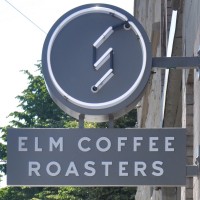
The Elm Coffee Roasters sign, hanging outside on a sunny Seattle day.Elm Coffee Roasters is a relatively new addition to Seattle’s excellent speciality coffee scene, having only opened in December 2014 and celebrating its six month anniversary not long before my visit in the summer of last year. On 2nd Avenue in downtown Seattle, it’s very close to King Street Station, which makes it the ideal spot to start your coffee tour of Seattle if arriving by train or bus. Which I did, Seattle being the last stop of my coast-to-coast journey that had started in Portland, Maine. And I didn’t go, because I forgot to check my phone and didn’t realise how close Elm was when I got off the train! And I’m still kicking myself even now, nine months later.

It’s not just that Elm is a beautiful, large, uncluttered sun-drenched space and an amazing location for a coffee shop. It’s also a roaster, with all the coffee being roasted in the Probat at the back of the store, in plain view for all to see. In that respect, it’s like Stoked Roasters + Coffeehouse in Hood River, or, for UK readers, Birmingham’s Quarter Horse Coffee. Best of all is a coffee menu that lets you try absolutely everything!

Continue reading

Butterworth & Son

A lovely flat white in a Butterworth & Son cup, with particularly intricate latte art, made at the roastery with Butterworth & Son's What's Guat! blend.The subject of today’s Meet the Roaster is Butterworth & Son, a Suffolk roaster with a long pedigree and a name that’s as well known (locally) for its tea as for its coffee. Butterworth & Son was catapulted to fame in specialty coffee circles with the success that Howard Barwick had with its coffee in the 2012 UK Barista Championship (UKBC), another example of the beneficial impact of barista competitions on the industry.

These days, Butterworth & Son has a national (coffee) reputation, roasting up to 20 different green beans at a time on a new, 12kg Diedrich roaster. Predominantly, these go into espresso blends, but about 30% of the output is single-origin coffees, all of which is available to buy on-line.

Butterworth & Son hasn’t forgotten its roots, both in terms of product (tea still plays a major role in the company) and geography. As well as its roastery in an industrial estate in Bury St Edmunds, it has recently opened a café, Guat’s Up! (named after its bespoke espresso blend of two Guatemalan coffees) in the town and Butterworth & Son is committed to improving the quality of the local speciality coffee market.

Continue reading

Ancoats Coffee Update

Freshly-roasted coffee beans cooling in the pan of Ancoats' Giesen roaster.I never done this before, updating a Meet the Roaster… Technically, this means it’s a Saturday Update, but also a Meet the Roaster… Fortunately, I suspect that I’m the only one who actually cares about these things…

I first visited Ancoats in August 2014, when it occupied the corner of a small unit in the corner of an industrial estate in Manchester’s Ancoats district. Fast forward 18 months, and Ancoats, after only two years, was doing so well that it could move not only into bigger premises, but into an amazing café/roastery in Manchester’s Royal Mills development.

The Coffee Spot covered the café-side of things back in November last year, so today I’m focusing on the roastery. Ancoats has long been a favourite of mine, roasting some fine coffee, including some of my favourite decafs. This is joined by its ubiquitous Warehouse espresso blend and anything up to nine single-origins. You can get the Warehouse blend, decaf and a different single-origin every week on espresso at the café, while three single-origins are on filter at any one time. These change on a daily basis and, if you ask nicely, chances are that you can have any single-origin that’s in stock.

Continue reading

Avenue Coffee Roasting Co

Avenue Coffee's Diedrich roaster, with a batch of freshly-roasted beans in the cooling pan.Avenue Coffee grew out of the Avenue G café on Byres Road in Glasgow’s West End. The intention was for Avenue G to roast its own coffee and the second branch, on the Great Western Road, was designed with this in mind. More of a coffee shop than the original, the mezzanine level at the rear of the shop was set aside as the roastery and Tom, then head roaster, oversaw the procurement and installation of the Diedrich roaster.

However, Tom left and the roasting duties were shared by Katelyn and Todd, who have now been joined by Colin, who they are training up as a roaster in his own right. These days, Avenue Coffee roasts around 100 kg a week, of which between 40-60 kg is for its own use (one-third at Great Western Road, two-thirds at Avenue G) with the remainder going to the likes of Glasgow’s Spitfire Espresso and Rialto in Eyemouth. Output includes espresso blends (for example, Spitfire has its own bespoke espresso blend) and single-origins, a cracking decaf (which I’ve enjoyed at home) and several seasonal single-origins roasted for filter. These are all available to buy in the two Avenue stores as well as on-line.

May 2018: I’ve recently learnt that Avenue Coffee is no more. However, both Katelyn and Todd now have their own coffee roasting companies, Common Coffee in Edinburgh (Katelyn) and The Good Coffee Cartel in Glasgow (Todd, along with Courtney, another ex-Avenue Coffee person).

Continue reading

Outpost Coffee Roasters

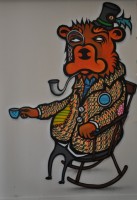
A stylised bear with very short legs sitting in a rocking chair and drinking a cup of espresso. The bear is wearing a smoking jacket, (small) top hat and a monocle and is smoking a pipe.Nottingham’s speciality coffee scene has come a long way since I first visited 2½ years ago, coming away disappointed. Now there’s a flourishing café scene, led by the likes of 200 Degrees, Wired Café Bar, The Pudding Pantry and, out in Beeston, Greenhood Coffee House. However, a good coffee scene needs local roasters too, and Nottingham is now blessed with both 200 Degrees Coffee Roasters and, more recently, Outpost Coffee Roasters.

Although a new name to the speciality coffee world, Outpost brings a wealth of experience in its founders, Greg and Alex. Greg has a long and distinguished history in coffee roasting, having owned Café Boutique, while Alex used to manage The Bean, a family-run coffee shop in Beeston (Alex’s mother still owns it). Greg wanted to take things to the next level and start roasting speciality coffee, while Alex wanted to branch out from the role of barista/shop manager. Together with Liz, who does the all-important admin, they make the perfect team.

Outpost has a training facility/espresso lab in a lovely first-floor space on Stoney Street, in Nottingham city centre, while the roasting takes place in an industrial estate on the city’s outskirts, using a 10kg Petroncini from Italy.

Continue reading

200 Degrees Coffee Roasters

The 200 Degrees Coffee LogoBefore there was ever 200 Degrees, the award-winning coffee shop in the centre of Nottingham, there was 200 Degrees Coffee Roasters, who first brought my attention to Nottingham as somewhere where you could get decent coffee.

200 Degrees grew out of Belle and Jerome, a well-known coffee shop in West Bridgford, just down from Trent Bridge cricket ground, and a desire of the owners, Rob and Tom, to roast their own coffee. The catalyst was third partner, Tim, who brought a passion for roasting, having caught the coffee-bug in New Zealand.

Called 200 Degrees after the temperature green beans are roasted at, 200 Degrees grew from fairly humble beginnings to become what is now a fairly major player in Nottingham’s growing speciality coffee scene. As well as supplying its own coffee shop, 200 Degrees also supplies a number of other local shops, roasting a couple of espresso blends, a filter blend and three or four single-origin filters.

As well as supplying coffee, plus the necessary kit to go with it, 200 Degrees is also expanding into training, both for its wholesale customers and for the general consumer, as seen in its training room at the 200 Degrees Coffee Shop.

Continue reading

Ancoats Coffee Co, Royal Mills

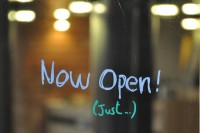
The words "Now Open! (just...)" written in blue pen on the window of Ancoats, Royal Mills.Once upon a time, in Ancoats, Manchester, a man called Jamie opened Ancoats Coffee Company. Roasting some fine coffee, including some of my favourite decafs, Ancoats went from strength-to-strength, until, on Monday, the Ancoats Coffee Co Coffee Roastery and Café Space (which is a bit of a mouthful, so we’ll stick with Ancoats for short) opened its doors in a magnificent new space in the Royal Mills. We’ll look at the roastery in a future Meet the Roaster; today we’re concentrating on the new café.

Superficially reminiscent of Sheffield’s Tamper Coffee at Sellers Wheel, Ancoats is housed in an old mill building, with a low, brick-arched ceiling and bare brick walls. Potentially a rather dark, unwelcoming space, with only borrowed light from windows at either end, Ancoats is made warm and welcoming by the clever use of lighting. You can also sit outside in the amazing, glass-ceilinged courtyard.

Ancoats, naturally, showcases its own considerable output, with the Warehouse blend, plus a decaf and a different single-origin every week on espresso. There are also three single-origins on filter, which change on a daily basis. If you ask nicely, chances are that you can have any of Ancoats considerable output of single-origins.

Continue reading

Avenue Coffee, Great Western Road

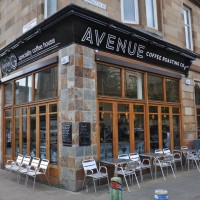
Avenue Coffee on the corner of Glasgow's Great Western Avenue and Barrington Drive.While in Glasgow for Caffeine Magazine in April 2014, I visited Avenue Coffee on the Great Western Road, where I met a young barista named Katelyn. Back then it had recently opened, was known as Avenue G, and, upstairs on the mezzanine level, a coffee roaster was being installed: Avenue G was about to start roasting under the name “Avenue Coffee”.

Realising that anything I wrote would be out-of-date before I even published it, I decided to wait until I’d had a chance to visit the roastery before writing up the Great Western Road branch. Fast-forward 18 months, the young barista had turned head-roaster, and I was finally able to accept Katelyn’s long-standing invitation to visit.  You can see what I made of the Avenue Coffee Roasting Company in the Meet the Roaster series; today I’m focusing on the coffee shop part of the operation.

Sitting on the corner of Barrington Drive, Avenue Coffee a lovely, sunlit spot, decked out in wood, brick and bare stone. Best described as the speciality coffee wing of Avenue G, it showcases the roastery’s output (plus guest roasters) with two options on espresso and three on filter, prepared through any of six brew methods.

May 2018: Avenue Coffee is no more, with both the roastery and the coffee shop having recently closed. The original Avenue G has also undergone some changes and is now known as Turadh.

Continue reading

Smokey Barn

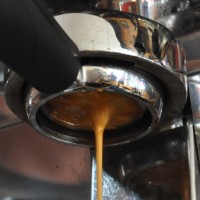
A beautiful espresso extraction from a bottomless portafilter at Norwich's Smokey Barn Coffee Roasters.Norwich has a small, vibrant and thriving coffee scene, based around old favourites such as The Little Red Roaster and Strangers Coffee House, along with (relative) newcomers such as Kofra. Part of that mix, although a little under the radar, is local roaster, Smokey Barn, the brain-child of civil-engineer-turned-coffee-roaster, Chris.

From humble beginnings in 2011, when he roasted in a shed in his garden (the original and literal “Smokey Barn”), Smokey Barn moved into its current premises, just 10 minutes’ walk from the railway station, at the start of 2014. Smokey Barn has one of the most beautiful interiors I’ve seen in a roastery (which are not usually renowned for their beauty), kitted out in brick and wood, a far cry from most, which are typically industrial units.

Smokey Barn typically roasts five single-origin beans, plus decaf, with the (very) occasional blend thrown in. These are all available on-line from Smokey Barn, or you can pop into the roastery itself and buy a bag or two from Chris (best call ahead first to check that he’s in, though). Even better, if you ask him nicely, Chris will make you a coffee as well, using Smokey Barn’s fully-equipped espresso bar.


June 2021: Chris sold Smokey Barn in 2016 (I think). I’m not sure what happened to the company over the intervening years, but these days it’s still going strong, run by sisters Sophie & Megan, who continue to roast, but have also turned the roastery into a coffee shop (and about time too in my opinion!). One day I hope to get back to Norwich so that I can do a proper update.


Continue reading