Surrey Hills Coffee

The Surrey Hills Coffee logo from the back wall of the coffee shop on Chapel Street, Guildford.Guildford has long been crying out for an independent, speciality coffee shop and finally, one has arrived! Surrey Hills Coffee, which has been roasting its own range of espresso & filter blends, plus a growing selection of single-origin coffees in the North Downs, has now opened its own coffee shop, taking over the lease on what was the Turn Fit Deli on Chapel Street.

It’s not a huge space, just a couple of tables, a window-bar and another bar at the back, but it’s bright and welcoming. The main draw is the coffee, although there is tea, soft drinks, plus a range of locally-baked cakes and made-to-order sandwiches, with ingredients from a range of local suppliers.

For somewhere so small, the range of coffee on offer is impressive: there are no fewer than three espresso blends, although if you don’t ask, you’ll get the default, the Holmbury Hill blend, which (in my opinion) is the best of the bunch. If you’re in a hurry, there’s the Cottage filter blend, available from a flask on the counter and made in small batches using the Moccamaster. Finally, if you don’t mind waiting, you can have a single-origin filter hand-made through the Chemex.

Continue reading

London Coffee Festival 2016: The Kit

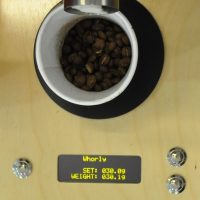
My surprise favourite bit of kit at this year's London Coffee Festival, the Marco Beverage Systems Bean Counter, doing what it does best (and indeed all it does), count (well, weigh) beans.Welcome to the third of my detailed write-ups of this year’s London Coffee Festival (if you want an overview of the whole festival, take a look at my round-up). Here I cover individual aspects of the festival, starting with some automatic filter machines and continuing with last week’s look at cups. This week I’ll be casting my eye over some of the other kit I found, before covering, in future Saturday Supplements, my coffee experiences and the coffee itself.

I’ve already looked at one specific aspect of the kit, the surprising proliferation of automated filter/pour-over machines, which I covered two weeks ago. This time it’s a round-up of various miscellaneous bits of kit that I came across, starting with my surprise favourite, the automated bean-counting machine. Another area which particularly excites me, as a coffee shop customer, is the emergence of the modular espresso system, typified by the Mavam, which made its London Coffee Festival debut this year. Finally, I take a look at top-end grinders which are making espresso extraction ever more reliable. In this instance, it’s the Mahlkönig Peak, which was launched the festival.

Continue reading

Kin

A large chalk drawing of an octopus saying "Yo Kin" in a speech bubble, above the handwritten details of Kin's filter of the weekI’m always on the lookout for something slightly out of the ordinary, so I thought it was about time that I paid a visit to Kin, in Fitzrovia. In a city dominated by big-name local roasters such as Allpress, Caravan, Square Mile and Workshop, plus a host of other, smaller roasters, it’s always nice to find something from out of town. In this case it’s Bristol’s Clifton Coffee Roasters, with Kin using Clifton’s seasonal EQ espresso blend, plus a single-origin filter of the week on batch-brew, using the ever-reliable Moccamaster.

Kin, which will be two years old at the end of May, is in good company in this part of Fitzrovia. It’s on Foley Street, just along from Attendant and around the corner from the original Kaffeine. Long and thin, it’s an impressively bright spot, helped by generous windows at the front and a large skylight at the back. The focus at Kin is as much on the food as it is on the coffee (and loose-leaf tea from London’s Postcard Teas). There’s breakfast (served until 11.30) and lunch (12.00 to 15.30), plus copious quantities of cake to fill that awkward half-hour gap (cake is also available at other times).

Continue reading

Kaffeine Eastcastle

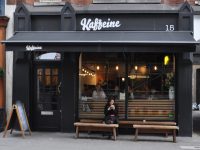
The front of Kaffeine, door to the left, windows to the right, with a pair of benches in front of the window acting as tables.Kaffeine, with its original store on Great Tichfield Street, is something of a legend in London coffee circles, part of the first wave of Aussie/Kiwi (in this case, Aussie) influenced coffee shops to appear in the capital. The second Kaffeine, a hop, skip and jump away on Eastcastle Street, took a while in coming, but in 2015 it opened its doors, effectively reproducing the original’s successful model in a similarly-sized, but differently-shaped space. This one’s a simple rectangle, with the short-side facing the street, counter on the right, seating on the left. There’s also a window bar and a long bench outside on the relatively quiet street (although I was there on Sunday).

There’s the ubiquitous Red Brick from Square Mile on espresso, all the usual favourites on the menu (the largest drink is a 7.5oz latte) and the added bonus of a coffee-tasting flight. There’s also cascara, a selection of loose-leaf teas and a small range of soft drinks. If you’re hungry, there’s a limited range of three baguettes/brioche (which can be toasted) and three salads, which you can have individually or in combination. Finally, there’s a selection of cakes, including the Aussie staple of toasted banana bread.

September 2020: Kaffeine Eastcastle has followed the original on Great Titchfield Street and reopened after the COVID-19 shutdown over the summer. You can see what I made of it when I visited later on in the month.

Continue reading

London Coffee Festival 2016: The Cups

The Kaffeeform cup, made from recycled coffee grounds, in action at the London Coffee FestivalWelcome to the second of my detailed write-ups of this year’s London Coffee Festival (if you want an overview of the whole festival, take a look at my round-up). Here I cover individual aspects of the festival, starting with last week’s look at automatic filter machines. This week I’ll be taking a look at cups, before covering, in future Saturday Supplements, miscellaneous coffee kit, my coffee experiences and rounding things off with the coffee itself.

In previous years, my posts on cups at the London Coffee Festival proved surprisingly popular. This year, however, cups were somewhat thin on the ground, with the familiar (to me, at least) JOCO Cup, UPPERCUP and Frank Green all missing. KeepCup was there, but since I managed to go a whole year with destroying either of my glass KeepCups, for once I didn’t need to visit the stand.

However, if you looked, there were still some cups to be found, including those made from interesting materials (porcelain, bamboo and recycled coffee grounds), while one was claiming to be totally spill-proof (although I managed to get it to spill…). I also saw the all-in-one portable coffee maker, Cafflano, and its new product, the Kompact.

Continue reading

Taylor Street Gallery

A latte-art style fern above the words "taylor st baristas" with "finely crafted coffee" written underneath, all in white on a black oval.I’ve long been a fan of Taylor Street Baristas, one of London’s best-known mini chains. However, I came to Taylor Street through its much-loved (now sadly-missed) branch on Brighton’s Queen Street. Until last week, the only Taylor Street Baristas I’d visited in London was the equally lovely Mayfair branch. That I tracked down the diminutive Taylor Street Gallery (sometimes known as the Monument branch) is due to a chance encounter with the manager, Lisa-Laura, at this year’s London Coffee Festival.

Taylor Street was founded in 2006 by the three Tolley siblings, who run the company to this day. Until recently, a variety of roasters appeared at the various cafés, but Taylor Street now roasts its own coffee. While production ramps up, the Gallery’s the only one exclusively using Taylor Street Roasted, with other branches taking it as a guest espresso/filter.

The Gallery itself is a delightful place which seats about 20 in a slightly subterranean setting, with two more small tables outside in the narrow alley it calls home. Despite the size, there’s a single-origin on espresso, two more on filter (batch-brew or V60), the coffee changing every couple of days. There’s a decent range of cakes and savouries too.

September 2019: as part of the sale of Taylor Street Barista’s coffee shops to the Black Sheep chain, the Gallery has closed.

Continue reading

Shoreditch Grind

The Shoreditch Grind logo, written on the wall of Shoreditch Grind.Shoreditch Grind is where London’s rapidly-expanding Grind chain (to-date, six, with a seventh coming next month) began in 2011, on the north side of London’s famous Old Street roundabout. In true Coffee Spot fashion, I’d already visited a couple of the other Grinds (the now-closed Piccadilly Grind and the still-going-strong Soho Grind). With that in mind, I decided it’s about time the Coffee Spot features the Grind mother-ship…

Although all the Grinds are different in terms of layout and atmosphere, this is the (successful) template that all the other Grinds follow, establishing the now-familiar formula of coffee by day and cocktails by night, along with an impressive (and evolving) food offering. This includes a full breakfast menu (served, as it should be, until three in the afternoon), sandwiches, cake and, in the evenings, small plates and more recently, pizza.

Grind will be roasting its own coffee in the near future, but for now Hove’s Small Batch fulfils that role, roasting the bespoke, seasonal house-blend (used in milk drinks), single-origin (used for espresso & short/long blacks) and the decaf, which all grace Grind’s espresso machines. There’s also Sandow’s cold brew on tap and a well-stocked bar for those evening cocktails.

January/May 2017: Grind is now roasting its own coffee. You can see what I made of it at London Grind (January) and Exmouth Market Grind (May).

Continue reading

Junction Coffee

The colourful front cover of the menu at Liverpool's Junction CoffeeJunction Coffee is the epitome of a neighbourhood café, serving the good folk of Aigburth, a suburb to the south of Liverpool city centre. Located near a busy junction (from which Junction Coffee gets its name) on the equally busy Aigburth Road, Junction Coffee has been quietly serving speciality coffee to its regulars since 2011 when the owner, Nathan, quit his job with the council to pursue his passion for coffee.

Junction uses Staffordshire’s Has Bean, which roasts a bespoke espresso blend for Junction, while there are usually two single-origin beans available through the Kalita Wave filter for those feeling more adventurous. There’s also hot chocolate, loose-leaf tea and a range of soft drinks.

However, there’s a lot more to Junction than just the coffee. It serves an impressive range of sandwiches, toasted sandwiches, panini, wraps and bagels, plus salads and a soup of the day. Add to that an impressive range of home-made cakes, plus ice cream, and Junction has you covered whatever the time of day.

October 2016: I heard the news that Junction Coffee has closed its doors for good over the summer.

Continue reading

92 Degrees Coffee

The 92 Degrees logo, taken from above the counter on the Hardman Road coffee shop.92 Degrees Coffee is one of several places to spring up in Liverpool in the last year or two. Whereas most coffee shops are started by people within the industry, 92 Degrees is the brainchild of five friends from the software business, united by a love of coffee/coffee shops. What’s more, while most start small and grow with small steps, 92 Degrees went all in, roasting its own beans onsite from the outset (the roaster, by the way, is Rob Leigh, author of From Lime Street to Yirgacheffe). You’ll be able to read more about the roasting side of things and the motivation behind 92 Degrees in the Meet the Roaster series.

92 Degrees occupies a large, bright, high-ceilinged space, the sort of coffee shop that you could easily lose yourself in for an afternoon. Meanwhile, the roaster turns out some very good single-origin coffee. There are two single-origins and a decaf on espresso, and a further five roasted for filter, all through the V60. All the beans are available for you to take home, along with a selection of coffee kit. If you’re hungry, there’s a good range of cake, toasted bagels and a small selection of sandwiches.

Continue reading

London Coffee Festival 2016: Round-up

The London Coffee Festival LogoAnother year, another London Coffee Festival come and gone. This time last week I was right in the thick of it, just about to throw myself into the third of four days of this year’s London Coffee Festival. Yes, that’s right, this year, for the first time ever, I attended all four days, both industry days on Thursday and Friday, and the two consumer days on Saturday and Sunday.

Just as for previous years’ festivals, I’ll be writing a series of themed Saturday Supplements, each covering a different aspect of the festival. Today’s Saturday Supplement is a general round-up, including what I made of the festival, the highs and lows, and what differed from last year. The remainder in the series, to be published over the coming weeks, will cover automated filter machines, cups, coffee kit, my coffee experiences and the coffee itself.

Something that I’ve noticed is that the organisers of the London Coffee Festival do seem to learn from experience and listen to feedback. Several issues from previous years have been addressed and while the festival is not perfect, it keeps on going from strength-to-strength as it continues to grow. This year, with over 30,000 visitors, was easily the biggest so far.

Continue reading