Quarter Horse Coffee Roasters

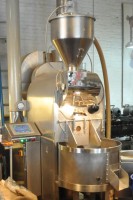
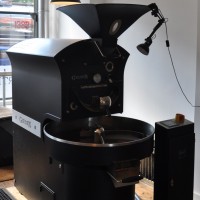
The Giesen roaster at Quarter Horse, Birmingham.Quarter Horse Coffee started life on Oxford’s Cowley Road (where the original Quarter Horse Coffee has become Peleton Espresso), where it used coffee from Square Mile. However, in 2015, Quarter Horse moved to Birmingham, setting up a café/roastery. Nathan, who founded the original Quarter Horse with colleague James, hails from Normal, Illinois, and was a roaster before he came to the UK, so this marked a return to his (roasting) roots.

Quarter Horse created a lovely spot on Bristol Street, the roastery sharing the space with a large, open café (which features in its own Coffee Spot), Originally, this was behind a waist-high counter, which meant that the roastery was visible from pretty much every part of the building, but a major remodelling during the enforced COVID-19 shutdown saw the roastery enclosed in its own room. The roastery is still going strong, with the roaster, a 15 kg Giesen (which has been the mainstay of the operation since it opened in 2015), visible through a window in the wall dividing the roastery from the café.
Continue reading
Amid Giants & Idols

The Amid Giants & Idols logo from the A-board outside.Halfway between Dorchester and Exeter, the Dorset seaside town of Lyme Regis is not somewhere you would stumble upon by accident (the A35, the main Dorchester-to-Exeter road, runs a few miles inland, requiring a very deliberate detour to reach Lyme Regis). With a permanent population of less than 4,000 people, it’s not somewhere you’d expect to find one of the country’s best speciality coffee shops either, but tucked away halfway up a hill on Silver Street, there’s the wonderful Amid Giants & Idols.

A warm, friendly place, run by the lovely Xanne, stepping into Amid Giants & Idols is a bit like popping round to her place for a cup of coffee and a slice of cake, where she entertains you in her (slightly) over-sized sitting room. It really is that cosy and informal. If that’s all there was to Amid Giants & Idols, then it would be a pretty special place, but add to that some wonderful coffee, as good as you’ll find, and you’re onto a real winner. That it’s all roasted (with passion, as it says on the A-board outside) on a vintage Swadlo roaster in a shed at the back of shop, is an unexpected bonus.

Continue reading

Meet the Roaster: Tandem Coffee Roasters

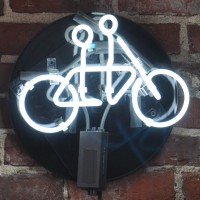
A light bulb in the shape of a tandem bicycle from the wall of the Tandem Coffee Roasters RoasteryI first came across Tandem Coffee Roasters in Boston, where I enjoyed a cappuccino at Render Coffee, made using Tandem’s seasonal Time and Temperature espresso blend. I also met with Larry, owner of Boston’s Pavement Coffeehouse chain, who sang the praises of Tandem’s co-founder, Will (an ex-Pavement employee). That pretty much sealed it for me, and when, a few days later, I popped up the New England coast to Portland to start my coast-to-coast, Portland-to-Portland train trip, I naturally sought out Tandem’s roastery.

What I found wasn’t just a thriving roastery, but an excellent, friendly coffee bar too. The coffee bar aside, which features in its own Coffee Spot, this Meet the Roaster post focuses on the roastery side of the business. When I first visited in 2015, the roastery was in one half of a single-storey, L-shaped building, also home to the coffee bar. These days, it’s become so busy, it’s had to relocate to a separate building just behind the first, where a 35 kg Loring roaster takes pride of place, roasting all of Tandem’s coffee, for use in-house in the coffee bar and Tandem’s bakery/coffee shop on Congress Street as well as for Tandem’s growing wholesale business.

Continue reading

Brooklyn Roasting Company

The Brooklyn Roasting Company's 25kg Loring coffee roaster in its current home on Brooklyn's Jay Street.The subject of today’s Meet the Roaster is the Brooklyn Roasting Company. Tucked away on Jay Street, under the Manhattan Bridge, it was a highlight of my visit to Brooklyn back in March. Occupying the ground floor of a sprawling five-storey building, it’s an amazing place, which, as well as being a wonderful coffee shop, is also the Brooklyn Roasting Company’s headquarters, with all the roasting taking place on-site.

So, as well as popping in for a great cup of coffee, you can also sit in the far corner watching the green beans being hoovered into the 35kg Loring roaster and enjoying the spectacle of freshly-roasted beans pouring out some 12 minutes later. Don’t worry about when to come if you want to catch the roaster in action; it’s pretty much a nonstop, all-day operation!

Although the Brooklyn Roasting Company is a very modern affair, the building on Jay Street is steeped in coffee history. It used to be the stables of the famous Arbuckles’ coffee roastery, which was situated across Jay Street, the horses being used in the late 19th and early 20th centuries to haul the sacks of green beans from the ships docked at the nearby waterfront.

Continue reading

Street Bean Coffee

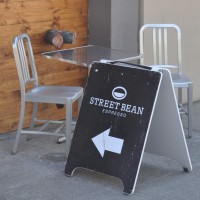
The A-board outside Street Bean Coffee on Seattle's 3rd Avenue, pointing the way inside.Coffee with a conscience, community coffee, social coffee; the list goes on. The idea that a coffee shop can do more than just serve good coffee seems to be taking off, with several social enterprise coffee shops springing up, with some London’s leading society enterprises being featured in Issue 15 of Caffeine Magazine. However, while in Seattle, I was lucky enough to visit Street Bean Coffee, a pioneer in this area which first opened its doors in 2009.

Sitting in the shadow of Seattle’s futuristic Space Needle on 3rd Avenue, Street Bean doesn’t wear its heart on its sleeve. Rather than relying on pricking your conscience, Street Bean is happy to stand up on its own two feet as a coffee shop, something it does very well. Street Bean is a multi-roaster shop, quite a rare thing in the US, offering single-origins and blends on espresso, a wide range of single-origin pour-overs and the obligatory bulk-brew (yet another single-origin option).

By the time you read this, Street Bean will also have starting roasting in the space next door, with initially a 1.5 kg roaster, which will be used for training. Check its website for more on what Street Bean does.

Continue reading

Quarter Horse Coffee, Birmingham

The Quarter Horse Coffee logo: a profile of a knight from a chess set, surrounded by an oval with the words "Quarter Horse Coffee" written around the outside.Quarter Horse Coffee opened its Birmingham café/roastery in February 2015, having moved from its original home in Oxford (which is now Peleton Espresso). Located on Bristol Street, a few minutes’ walk south of the centre, it underwent a major remodelling during the summer of 2020, making the most of the enforced shut down due to COVID-19. This saw the roastery, which had been in an open area on the left, enclosed in its own room, while the café on the right expanded its seating, even though the actual space is slightly smaller. This post is all about the café, by the way, while the roastery has its own Meet The Roaster feature.

Bright and spacious, Quarter Horse has a simple, extremely effective décor, being predominantly white, which, along with high ceilings, an uncluttered layout and windows front and back, make it feel even brighter and more spacious than it is. The coffee is all roasted on-site, with the house-blend and a second option on espresso, plus a single-origin on pour-over through the Marco SP9 automated brewers. There’s an all-day light food menu and plenty of cakes, while from Wednesday to Sunday, a full brunch menu is available from 10:00 – 14:00.

Continue reading

Tandem Cafe & Roastery

A light bulb in the shape of a tandem bicycle from the wall of the Tandem Coffee Roasters Roastery Tandem Coffee has undergone many changes since I first visited its cafe & roastery on Anderson Street in 2015 at the start of my coast-to-coast train journey from Portland (Maine) to Portland (Oregon). Back then, Anderson was just a dirt road, the neighbourhood was very much up-and-coming and Tandem occupied a squat, two-room building, housing both cafe and roastery. These days, the neighbourhood is almost unrecognisable, packed with new shops, restaurants, bars, breweries and, of course, ever-present throughout, there’s Tandem.

The cafe now occupies both rooms, the roastery having moved to a second single-story brick building behind the first. These days, the counter is in the old roastery space, directly ahead as you enter, seating arranged around the walls and at the counter’s far end. Meanwhile, there’s more seating in the second room to your left, while you can also sit outside at a pair of picnic tables. Tandem’s concise espresso menu features a daily single-origin and decaf, while there are two/three single-origins on pour-over through the SP9/V60 (which can be had hot or iced). Alternatively, there’s batch brew, featuring either the Time & Temperature or West End Blues blends, cold brew and tea, plus a small range of cakes/pastries.

Continue reading

Foundry Coffee Roasters

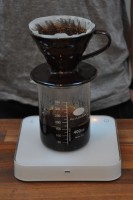
A V60 at Foundry Coffee Roasters, standing on a glass beaker half full of coffee, all on a set of scales.As I have written elsewhere about Sheffield’s coffee scene, it very much grew up independently and spontaneously about three years ago. This holds true as much for its cafés as it does for its roasters, typified by the subject of today’s Meet The Roaster series, Foundry. Set up almost three years ago by founder, Lee, Foundry is content to do its own thing, in its own way and at its own pace.

Concentrating on roasting solely single origins and on selling primarily directly to the consumer through the internet, Foundry initially focused more on the filter market than espresso, which makes up the bulk of a typical roaster’s sales. Then again, there’s nothing typical about Foundry! Foundry diversified into espresso when the second member of the team, Callum, came on board.

These days, Foundry roasts five or six single-origin beans, looking to extract the flavours that Lee identifies in the green bean. The aim is to get the optimum roast profile and then work out what extraction method best suits it, with a focus on the clarity of the taste. You can find Foundry’s output on its website although the coffee’s also available in a limited number of coffee shops.

January 2017: Foundry now has a coffee shop of its very own on Bank Street in Sheffield City Centre. You can see what I made of it when I visited in February 2018.

November 2019: Foundry has moved to the Cutlery Works, a food hall on the banks of the River Don, combining its coffee shop and roastery operations. As a result, it’s closed the original roastery and the coffee shop on Bank Street (the coffee shop being taken over by Cassinelli’s).

Continue reading

Stoked Roasters + Coffeehouse

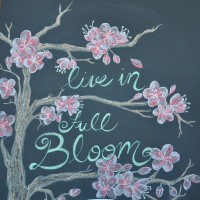
A chalk drawing on the wall at Stoked Roasters + Coffeehouse, showing a blossom tree in bloom with the words "Live in full Bloom"To celebrate Brian’s Travel Spot reaching the West Coast and the Columbia Gorge, I present Stoked Roasters and Coffeehouse in Hood River, on the Oregon side of the amazing Columbia Gorge. That I even know about Stoked is down to Chloe, aka The Faerietale Foodie, who visited a few months before me and informed me of this wonderful find.

Stoked is indicative of the spread of speciality coffee outside of the big America cities. Both roaster and coffeehouse, a model much more common in the US than it is in the UK, Stoked roasts all its coffee in the store itself on a lovely San Franciscan roaster. You can buy all the output, a mixture of single-origins and blends, from a retail shelf by the door. As is often the case in the US, the beans, even for the single-origins, are typically roasted more darkly than in the UK.

When it comes to the coffeehouse side of the business, Stoked offers a wide range of drinks, including house-blend, single-origin and decaf on espresso, the obligatory bulk brew and hand-poured filter on the V60. While I was there, there was a choice between three single-origins and, unusually for filter, two blends.

Continue reading

Little Red Roaster

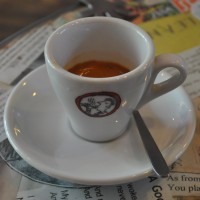
An espresso from Little Red Roaster in Poole, made with a single-origin coffee from the Doi Chaang community in Thailand and served in a classic white cup.Little Red Roaster in Parkstone, Poole, is not to be confused with Brighton’s Redroaster, although both possess a little red roaster. In the case of Poole’s Little Red Roaster, it’s a 3kg Toper which sits in semi-retirement in the far corner. These days it’s fired up once a week, although not long ago, this was a daily occurrence.

Little Red Roaster still roasts all its own coffee, the bulk of the roasting now done off-site by the owner’s son, Ben, using a 25 kg roaster. The various beans (up to eight) are for sale and can be tried as a pour-over for one, or a cafetiere for two. First thing in the morning, there’s also bulk-brew made with the coffee of the day (a Costa Rican during my visit). Finally, there’s the usual espresso offerings using Little Red Roaster’s speciality, a single-origin from Thailand.

If coffee’s not your thing, there’s tea and soft drinks, plus cake and a small food offering, freshly cooked in the little kitchen at the back. The options are mostly bagel-related, but there’s also a full English breakfast (plus veggie option) and specials, which are hidden on a chalk-board menu around the corner from the counter.

April 2016: I believe, from CoffeeGirlNeeds, that the eponymous little red roaster is no longer in the back of the store, replaced by extra seating.

Continue reading