AUNN Café & Co.

The sign hanging outside AUNN Cafe & Co. in ShanghaiAUNN Café & Co (an abbreviation of All U Need Now), which opened in early 2015, is a café, lifestyle store/design showroom and gallery space spread over three floors underneath a hotel on Shanghai’s busy West Nanjing Road. I was tipped off to its presence by Jennifer, a Shanghai resident who I met in And Coffee, and who gave me a long list of places to try.

AUNN café itself is the largest of the speciality coffee shops that I visited on my trip in 2016, spread across the ground floor of the building, the entire front given over to windows, complete with a coffee terrace outside on the busy road. When the weather’s warm but less humid than the October day I was there, the windows can be pulled back to create an open terrace.

The coffee comes from Little Bean in Pudong, with green beans sourced from Nordic Approach. There’s a standard, espresso-based menu, plus cold-brew and what AUNN calls “naked” coffee, filter to you and me. There are two single-origins available via the V60, as well as batch-brew if you’re in a hurry. There is also a small selection of western-style cakes and pastries if you’re hungry.

Continue reading

18 Grams, Times Square

The words "18 GRAMS" in white in a black circle. Some stylised coffee beans are drawn above the 18.My first experience of speciality coffee in Hong Kong was at the Causeway Bay branch of roaster/coffee shop chain, 18 Grams. Two days later, I found myself in Times Square (opposite Café Corridor) and decided to pop into the 18 Grams there. Although “pop in” might be over-stating things since it took me almost an hour to find it!

18 Grams’ Times Square branch is inside the City Super super market, which itself is in the basement of Times Square. Occupying a simple, triangular stand, with seating along two sides of the counter, 18 Grams only serves coffee, plus the usual retail selection of beans and coffee-related kit. There’s a more limited offering than at Causeway Bay, but that’s to be expected, with just espresso (a house-blend), several single-origins on V60 and cold-brew. What surprised me was the relaxed atmosphere, making it the ideal place to linger over your coffee.

Continue reading

Café Corridor

A single-origin Colombian espresso in a branded cup from Cafe Corridor in Hong Kong with 'A passage to the coffee world since 2001' written on the inside rim.That I found the Café Corridor was down to a tip-off from Andrea Burton. Even then, I walked along the street four times before I found it! In Causeway Bay, in the heart of Hong Kong, it’s opposite the gleaming towers and soaring halls of Times Square, hidden in plain sight in the manner of Newcastle’s much-missed Flat Caps Coffee on Ridley Place. The only indication that it’s there is the sign above the entrance, which, fittingly, is a long corridor leading you to the café in a basement-like structure at the rear of the building, complete with outdoor seating in an enclosed courtyard at the back.

Café Corridor has been going since 2001, a forerunner of Hong Kong’s growing speciality coffee scene and, like many such coffee shops, it has a western-inspired menu/coffee. It’s part of small chain of five co-owned independent coffee shops, which includes N1 Coffee & Co. Roasting is provided by its parent (which I’ll call Barista Academy), although each coffee shop has its own beans. In the case of Café Corridor, this includes a house-blend and five seasonal single-origins which can be had as an espresso or filter through V60/Syphon/Aeropress. Iced versions are also available.

Continue reading

Nem Coffee & Espresso

A lovely shot of the house-blend at Nem Espresso & Coffee in Tokyo, served in a classic white cup.The delightful Nem Coffee & Espresso is definitely the hidden gem of Tokyo’s speciality coffee scene. Located south of the Arisugawa-no-miya Memorial Park, Nem is tucked away down a narrow, pedestrian alley, so much so that you think you’re walking into a residential neighbourhood to visit someone’s house, which is not as far from the truth as it seems. The coffee shop is on the ground floor of an old house, painstakingly renovated/converted by the owners, a married couple who live upstairs, Nem opening for business in May 2016. The result is a small, but delightful space, with windows front and back, with a very Japanese feel to the architecture, but a very western feel to the coffee shop itself.

Talking of coffee, Nem has a concise menu, drinks split between “black” and “with milk”. There’s a house-blend on espresso (from Switch Coffee Roasters) and two single-origins plus a decaf (from Nozy Coffee) on filter through the cafetiere (hot) or Kalita Wave (cold). There’s also tea and hot chocolate, plus a small food menu, with a choice of two cakes. Small is definitely the name of the game at Nem, with all the food being cooked to order in a compact, open kitchen behind the counter.

Continue reading

Vermillion Café

A lovely espresso at Vermillion Cafe in Kyoto, made using its bespoke house-blend and served in a classic cup.Vermillion is a chain of precisely two in Kyoto, with an espresso bar next to the Inari train station and, five minutes’ walk away, by a large pond at the foot of Mount Inariyama, is the Vermillion Café, subject of today’s Coffee Spot. I didn’t spend long enough in Kyoto, Japan’s old Imperial capital, nor did I get to many coffee shops, but with my visit to Vermillion, I definitely saved the best until last!

Vermillion Café has a small outside seating area at the front (northern) end, which catches the evening sun, while inside, it’s long and relatively wide, with a couple of large tables. However, the best part is at the back, where the south-facing wooden terrace overlooks the pond. Here you’ll find the best views and perhaps my favourite spot for coffee in the whole of Japan.

Vermillion serves coffee roasted by the local Weekenders Coffee, with a bespoke house-blend on espresso and a choice of a blend or single-origin on pour-over through the V60, all of which can be had hot or over ice. There’s also a limited range of tea, beer and soft drinks, plus, if you’re hungry, a small selection of sandwiches and cake.

Continue reading

Seesaw 433

The Seesaw logo.Seesaw is a roastery and a chain of seven Shanghai coffee shops, although this one, Seesaw 433, is the original, having opened in 2012. Like most of the places I visited in Shanghai, it helps to know where it is, only more so in this case, since it’s at the back of a design centre, with no obvious signs on the street. If I hadn’t have known it was there, I would have missed it completely.

However, it would have been a shame to walk past since it’s a beautiful spot, with an enclosed courtyard, complete with glass roof. Perhaps because the courtyard is completely enclosed, it’s no smoking, but despite this, it can still get very hot and humid. If you want air-conditioning (or power outlets for your laptop), you’ll need to head inside the coffee shop proper, off to one side of the courtyard.

Seesaw roasts all its own coffee in a dedicated facility. There’s a seasonal house-blend and single-origin on espresso, with six or seven further single-origins on pour-over/cold brew, with all the typical origins represented. You can also buy the beans to take home with you, while if you’re hungry, there’s a selection of western-style cakes.

March 2019: Sad to say, Seesaw 433 has closed. It looks to me as if the whole building has been vacated rather than Seesaw itself moving/closing down.

Continue reading

The Coffee Academics, Wan Chai

One of the many interesting statements on the seats of the stools at the communal tables at the Wan Chai branch of The Coffee Academics in Hong Kong.The Coffee Academics is a roaster with a chain of coffee shops which, starting in Hong Kong, where there are multiple branches, has now spread to Shanghai and Singapore. It places itself firmly at the top end in terms of quality, with marketing to match. For example, I’ve never seen a coffee shop with such a fancy menu. Fortunately, the coffee (and the coffee shop) more than live up to the hype.

There’s a house-blend on espresso, with a range of standard drinks, most of which can also be had over ice. The real treat is the filter section where there’s a house-blend and four single-origins, all matched to a pair of preparation methods (Chemex and ice-drip for pour-over, Aeropress and Clever Dripper for immersion).

There’s an equally impressive range of food, which occupies most of the 16 page menu. This includes breakfast, lunch and dinner, plus various dessert options. In keeping with most of Hong Kong’s speciality coffee culture, the food is very western, with staples such as Eggs Benedict on offer. Consistent with the high-end setting, The Coffee Academics is table service only, so find a seat, peruse the menu and wait for someone to take your order.

Continue reading

Vietnamese Coffee Part III

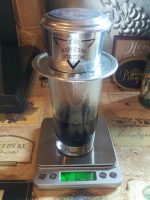
My traditional Vietnamese cup-top filter from The Espresso Station in action at my friend's house in the USA.Welcome to the third and final part of my exploration of traditional Vietnamese coffee following my recent visit to Vietnam. Part I covered my introduction to Vietnamese coffee and the traditional cà phê phin, a cup-top metal filter. I explained how, after a few false starts, I discovered a taste for speciality coffee made with the cà phê phin when I tried it at Shin Coffee in Ho Chi Minh City.

In Part II, I continued my exploration, trying traditional Vietnamese coffee, both speciality and non-speciality, over ice, and with condensed milk, with mixed results. I also tried the (in)famous egg coffee, traditional Vietnamese coffee with a layer of whipped egg yolk and condensed milk. Think of it as a liquid pudding rather than coffee and you’ll be fine.

In this, Part III, you can see how I got on making traditional Vietnamese coffee in various hotels and back at home using my own cà phê phin which I bought at The Espresso Station in Hoi Ann. I’ve tried a number of different beans, and used a couple of recipes which I picked up simply by observing baristas making coffee at the likes of Shin Coffee and Hanoi’s The Caffinet.

Continue reading

The Caffinet

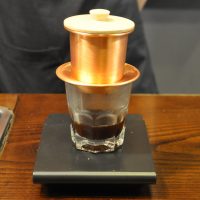
A traditional cup-top filter at The Caffinet in Hanoi.At last! A coffee shop in Vietnam not recommended by either Bex (Double Skinny Macchiato) or Simon (Fancy A Cuppa). Instead, today’s Coffee Spot, The Caffinet, was recommended by the wonderful folks at Oriberry Coffee (and, in fairness to Bex/Simon, it opened after their respective visits). On a busy street to the northeast of Hanoi’s Old Quarter, it’s another with a modest exterior that hides a delightful, and spacious, interior.

Spread over two floors, The Caffinet (which translates loosely as The Coffee House) opened in 2016 with the aim of serving Vietnamese-grown coffee and tea with a distinctly western-style. It does this using coffee from La Viet, a coffee shop/roaster in the Dalat coffee-growing region of Vietnam, and, tea from Long Dinh, which comes from Vietnam’s Lam Dong tea-growing province.

Unusually, there’s no hulking espresso machine at The Caffinet. Instead, espresso drinks are provided by the ROK hand espresso machine, which sits quietly on the counter. This is joined by a bewildering array of pour-over and immersion brewing methods. I think that the only one I didn’t see was the Clever Dripper! Finally, since this is Vietnam, there’s the traditional Vietnamese cup-top filter. Naturally, all the beans are for sale.

Continue reading

Oriberry Coffee, Hàng Trống

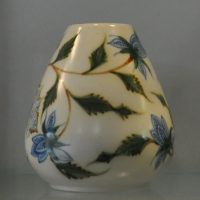
A beautiful vase from Oriberry Coffee in Hanoi.On my recent trips, I’ve had the very good fortune of having some outstanding coffee shops right next to my hotels, but in this case, good fortune had nothing to do with it. I’d deliberately picked my hotel, buried in the warren of narrow streets west of the lake in the heart of Hanoi’s Old Quarter (Hoàn Kiếm), because it was next to two of Bex (Double Skinny Macchiato) top two recommendations, RuNam Bistro and today’s Coffee Spot, Oriberry Coffee.

Oriberry is a Vietnamese social enterprise founded in 2010 to work closely with Vietnamese coffee and tea farmers, the ideals at the heart of the third-wave coffee movement. Oriberry is a chain of four coffee shops, which also double as retail outlets for its range of pottery, which is handmade in the nearby village of Bat Trang, and coffee, all of which is roasted in-house.

Oriberry serves two espresso blends, one, the 64 blend, a mix of Robusta and Arabica beans, the other, the 73 blend, pure Arabica. Both are available as espresso, while the 64 is also available as traditional Vietnamese Coffee, made with the cà phê phin cup-top filter. There’s also a range of Vietnamese tea and cakes.

Continue reading