Ratio &C

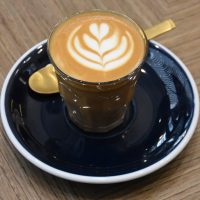
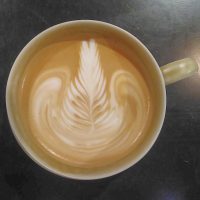
Some lovely latte art in my latte at Ratio &C, part of the Onibus chain in Tokyo.Ratio &C is part of Tokyo-based coffee shop/roaster chain, Onibus, which started in Okusawa, where it’s still going strong (and which, naturally, I’ve not yet visited). There are now five shops, including the original Nakameguro roastery/coffee shop, a new roastery/coffee shop in Yakumo, and Shibuya’s About Life Coffee Brewers. And, of course, today’s Coffee Spot, Ratio &C, a lovely coffee bar inside a cycle shop.

Ratio &C is a few minutes’ walk from my hotel, which is how I came to visit it when in Tokyo last October as part of my around the world trip. Back then, I’d have described Ratio &C as a classic coffee bar in cycle shop, but on my return last week, I found that the coffee shop had expanded a little, with more seating and less emphasis on the cycling. It’s a very peaceful environment, the ideal post-work spot where I could catch up with things before retiring to my hotel for the evening.

There’s the standard Onibus offering, with the Step blend on espresso for milk-based drinks. It’s also available on pour-over, along with another blend and a seasonal selection of single-origins, one of which is available on espresso each day.


Continue reading

Maruyama Single Origin

Detail from the sign above the door of Maruyama Coffee's branch in Nishi AzabuIf you’ve been keeping up with my adventures in Japan over the last two years, you’ll know that Maruyama Coffee, the regional chain from Nagano prefecture, holds a special place in my heart. My first ever coffee in Japan was at Maruyama in Nishi Azabu, while more recently I’ve visited Maruyama in Nagano Station. Today’s Coffee Spot is Maruyama Single Origin, a relatively recent addition, which opened last year in Tokyo’s Aoyama neighbourhood.

Maruyama Single Origin occupies a small, two-storey building, with downstairs serving retail/takeaway customers, while upstairs offers Maruyama’s traditional full table service. You get the usual Maruyama excellence, but with the twist that the store only serves single-origins, with a daily option on espresso and the full range (usually around 30 single-origins, from up to 10 different countries, including several exclusive to the store) available through syphon and cafetiere.

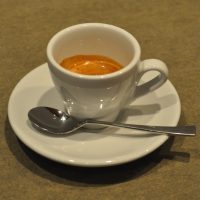
If anything, the focus is even more firmly on the coffee, with delights such as an espresso and cappuccino set and, a new one on me, the same espresso served in two different cups. Perhaps as compensation for this, there’s a reduced food offering compared to the other locations, with just a small selection of cakes, plus toast.

Continue reading

% Arabica, Arashiyama

The latte art in my Therma Cup at % Arabica, Arashiyama.% Arabica is an international coffee shop/roaster chain which, like Omotesando Koffee, has its origins in Japan. In the case of % Arabica, it started in Kyoto, rather than Omotesandō, before spreading around the world, although so far I’ve only visited its locations in Kyoto and Shanghai. Today’s Coffee Spot, in Arashiyama, on Kyoto’s northwestern edge, has a stunning location on the edge of the Katsura River as it gushes out from a narrow valley through the mountains.

It’s an amazing location, both in which to enjoy your coffee and for the baristas, who share the spectacular views with their customers. It is, however, a tiny spot, little more than a counter in a single room, with limited seating, most of which is outside. There’s the usual concise espresso menu, with the option of the house-blend or a single-origin, an Ethiopian Yirgacheffee Adado, but the usual filter options are missing.

Continue reading

Blue Bottle Coffee, Nakameguro

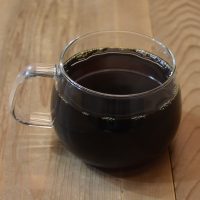
My single-origin pour-over served in a beautiful glass cup at Blue Bottle Coffee in Nakameguro.It’s weird, given how few of Blue Bottle’s US outlets meet my “places where I like to have coffee” criteria, that I’ve adored all three Blue Bottle locations that I’ve visited in Tokyo. Today is the turn of Blue Bottle’s Nakameguro coffee shop, which I first visited during last summer’s trip. It occupies a tall, narrow building, all concrete and glass, that was purpose-built as a factory. The coffee shop is at the front on the ground floor, with additional seating in a basement-like space to the rear, above which is a training area/lab. The top two floors, meanwhile, are Blue Bottle’s offices.

The offering’s very similar to the other Tokyo Blue Bottles that I’ve visited, with reduced food options compared to the Aoyama coffee shop. The usual espresso-based menu has the current seasonal blend plus a single-origin, with options including macchiato, Gibraltar, cappuccino and latte, along with cold-brew and iced coffee. This is allied with a strong pour-over offering, with six Blue Bottle drippers lined up on the counter-front, each standing on in-built scales. There’s a choice of a dedicated pour-over blend, plus a daily single-origin (different from the espresso). If you’re hungry, there’s cake, waffles and a panini.

Continue reading

Brian’s Travel Spot: Flying Finnair, Part II – Helsinki to Tokyo

My espresso on board a Finnair Airbus A350-900 bound for Tokyo Narita airport.Welcome to second instalment of the latest Brian’s Travel Spot, covering my journey to Tokyo, flying with Finnair via Helsinki, a new route and new airline (for me). Part I covered my journey from Manchester to Helsinki, while this, Part II, covers my onward flight from Helsinki to Tokyo’s Narita airport.

On my previous three trips to Japan, I’ve flown British Airways, and, wherever possible, I fly direct (one less thing to go wrong). However, since I was starting in Manchester, I had to change planes somewhere, so I decided to try the Manchester-Helsinki-Tokyo route, flying with British Airways’ One World alliance partner Finnair.

Compared to the route I would normally take, flying to Heathrow with British Airways and on from there, this meant a longer first leg, heading over the North Sea to Helsinki (approximately two hours in the air versus 35 minutes), followed by a shorter second leg, roughly 9½ hours as opposed to 11½ hours. That may not seem like much, but when you’re trying to sleep on the plane, that’s actually two hours less sleep, which can be crucial!

Anyway, I’m getting ahead of myself: my first challenge was to make my connecting flight at Helsinki.

Continue reading

Sentido Speciality Coffee

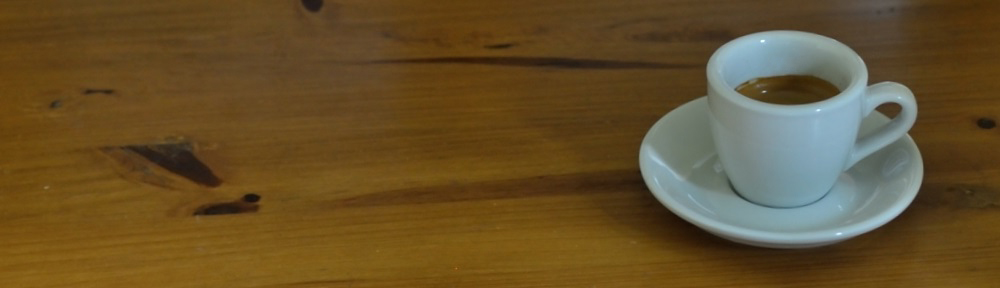
A lovely single-origin Rwandan espresso, served in a classic white cup in Sentido Speciality Coffee in Kyoto.Sentido Speciality Coffee is in the heart of Kyoto, south of the Imperial Palace and east of Nijō Castle. It’s also a few blocks from Weekenders Coffee, so it’s in pretty good company! I visited in  2017, during my first trip to Japan, tipped off by both Commodities Connoisseur and Double Skinny Macchiato. However, I didn’t have time to properly write it up, so a return visit was top of my list when I got back to Kyoto last weekend.

Down a side street off Takamiyacho, the main east-west artery, you’re unlikely to randomly wander by and, even if you do, you might well miss it, given its relatively small façade, set back slightly from the street. Inside it’s slightly larger than it seems, going back a long way, but it’s not what I’d describe as large.

The coffee, roasted by Cafetime Kyoto, is packaged/sold under the Sentido label, with all the beans available to buy in retail bags. There’s a blend and single-origin on espresso, while all the coffees, including the blend, are available through the cafetiere, with samples to try on the counter-top. If you’re hungry, there’s a range of sandwiches and cake, with plenty of vegetarian options.

Continue reading

Party At Moorgate

A lovely piccolo, made with the Captain Blend and served in a glass at Party at Moorgate.Party at Moorgate is the second coffee shop from Winchester-based, coffee-roasting Aussies, The Roasting Party. Opening at the end of April, it’s a tiny space, instantly reminding me of the long-defunct original incarnation of Mother’s Milk. Located on the corner of Moorgate and London Wall, it’s a stone’s throw from Moorgate Station (and even closer to long-time residents, Wild & Wood). The only seating’s an L-shaped padded bench with two small, round tables, although to The Roasting Party’s credit, there are plenty of power outlets, which includes USB sockets.

The coffee offering’s similarly compact, with two blends and decaf on espresso (Captain for milk-based, Drake for espresso/long black), plus two daily batch brew options. This is backed up with a selection of cakes and filled croissants, but otherwise, that’s it. A word of warning: Party at Moorgate’s been cashless since the end of June, so remember to bring your card.

Continue reading

Higashide Coffee

The sign which hangs outside Higashide Coffee in Kanazawa.This time last week I was in Kanazawa on the north coast of Honshu, part of my short trip around Japan’s main island, where I unexpectedly found some excellent coffee. I say unexpectedly, since I wasn’t really looking, but I really struck it lucky with my hotel, with great coffee shops of varying styles and character all within a few minutes’ walk.

Higashide Coffee is a coffee shop/roastery in the mould of a traditional Japanese kissaten, such as Café de L’Ambre or Chatei Hatou, although the layout reminded me of a traditional American diner (Charlie’s Sandwich Shoppe, for example). All the coffee’s roasted on-site using what looks to me, at least, to be a very old Fuji Royal roaster, which sits in the window. In a move that I’ve not seen before, all the green beans are hand sorted before roasting, which is an impressive level of dedication!

There are around 20 origins to choose from, with roasts ranging from fairly light to very dark. They’re all available as pour-over, made to order behind the counter, while there’s also a limited espresso menu, plus a small selection of cakes. Be warned though, Higashide allows customers to smoke and, like many Japanese coffee shops, it’s cash only.

Continue reading

Ogawa Coffee, Kyoto Station

A lovely single-origin Ethiopian pour-over from Ogawa Coffee at Kyoto Station.Yesterday I took the Shinkansen from Kyoto Station, on my way towards Tokyo, stopping en-route in Hamaya to visit Dark Arts and in Zushi (Breather Coffee). It therefore seems fitting that today’s Coffee Spot is the Kyoto Station branch of Ogawa Coffee. I had my first-ever Kyoto speciality coffee there on arriving from Tokyo in April 2017, and on my return, I had my final coffee (along with my breakfast) before leaving Kyoto yesterday morning. Not that 2017 was my first experience of Ogawa Coffee. Rather that came a year earlier in 2016, at Ogawa Coffee in Boston. Naturally, when visiting Kyoto, the home of Ogawa, I had to try at least one branch of Ogawa, and where better to start (and end), than at the station?

Despite being what could be described as a station takeaway café, Ogawa doesn’t compromise when it comes to coffee. There’s a concise espresso menu, offering espresso, cappuccino or latte, the latter being available hot or iced. There’s also filter, with a choice of the house-blend on batch-brew, and two single-origins as pour-over or Aeropress. You can either sit-in or have your coffee to go, which you can order from the separate retail counter.

Continue reading

Wood St Coffee Roastery

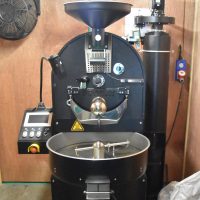
The roaster, a 5 kg Probat, at Wood St Coffee in Walthamstow.Welcome to what has turned into a very rare occurrence: a new Meet the Roaster feature! This is just the second of the year after Peixoto Coffee Roasters, which came out in February. Mind you, that’s an improvement on last year, when I managed just one! The focus of today’s Meet the Roaster is Walthamstow’s Wood St Coffee, which started off six years as a Sunday pop-up in Wood Street Market, run by Gareth with the support of his girlfriend, Claire. Fast-forward six years, and Wood St has gone from a one-man, once-a-week operation to a thriving coffee shop and now roastery, employing multiple staff, a real success story and a testament to the hard work of Gareth, Claire and all their staff.

Although the roastery’s output is primarily to support the coffee shop, Wood St has a growing wholesale market, as well selling direct to the consumer. You can buy 250g bags of Wood St’s coffee in the coffee shop itself, or on-line on Wood St’s website. These days, all the coffee is roasted on-site using a 5 kg Probat in a container outside Wood St’s home in the Blackhorse Workshop, although, as we’ll see, that’s a fairly recent development.

Continue reading